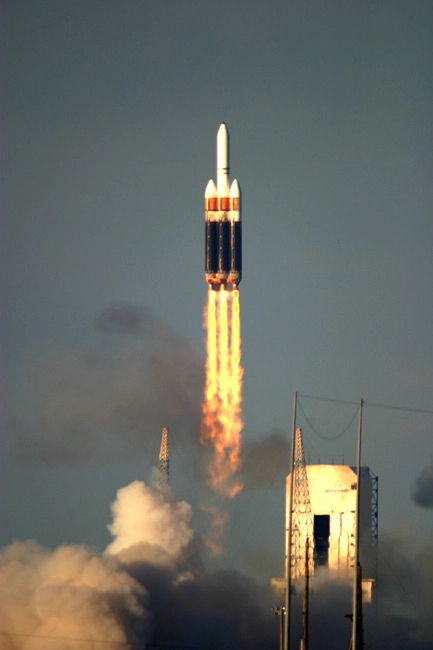
CAPE CANAVERAL, Fla. - Boeing's Delta 4 rockets are beingretrofitted with new pressure valves to alleviate bubbling in liquid oxygenfuel lines that possibly occurred in the fleet's maiden liftoff in 2002 andinvestigators determined caused engine trouble during the first Heavy booster'sDecember test flight.
The so-called cavitation is aphenomenon when super-cold cryogenic liquid oxygen changes to vapor bubbleswithin a rocket's feedlines running from fuel tanks to engines.
Rocket designers never caught thepotential for such a problem in the Delta 4's first stage until after theHeavy's demonstration launch that suffered early extinctions of its three mainengines during ascent. The shortened firings resulted in the rocket failing toachieve the proper altitude to deploy a pair of student-built nanosatexperiments and a massive satellite mockup.

The inquiry into the incidentformally concluded with corrective actions to fix both the Delta 4-Medium and-Heavy rocket versions to prevent a repeat on future launches.
Government and industryinvestigators said the bubbling started at the entrance of the liquid oxygenfeedline where a filtration screen, the line's elbow bend and an internalgimbal strut altered the fuel flow. This changed the fluid's speed anddecreased pressure as the liquid oxygen streamed from the tank.
The Delta 4-Heavy features threeCommon Booster Core stages mounted together, each identical with a liquidoxygen tank on top, the large liquid hydrogen fuel tank accounting for three-quartersof the stage's length and a Rocketdyne RS-68 engine at the bottom.
All three CBCs on the Heavy demoflight saw cavitation. The bubbles made their way fivefeet downstream from the liquid oxygen tanks to internal sensors used to tellthe engines when the fuel supply is expended and command the shutoff sequence.The bubbles fooled the sensors into thinking the tanks were going dry andtriggered the engine cutoff despite plenty of liquid oxygen still aboard.
"This feedline design has beenpresent in all previous Delta 4 flights, but the unique combination of vehicleacceleration, liquid level in the tank and propellant flow rate for the Heavymission reduced the fluid pressure enough to enable the creation of gaseousoxygen at this location as the tanks emptied," investigators determined.
"Further draining of the liquidoxygen tank worsened the conditions at the feedline inlet, causing thecavitation effect to extend further down the feedline. A pocket of gaseousoxygen continued to enlarge until it reached the Engine Cut-Off (ECO) sensorsand caused the ECO sensors to momentarily indicate dry. This ECO sensor dryindication was sensed by the flight computer, which initiated the sequence tothrottle-down and shut off the main engines as it is programmed to do.
"In reality, flight data showedthat sufficient propellant remained in the tank to complete the planned firststage burn time."
Despite extensive analytical work tounderstand the rocket's performance before the Heavy flight and even the firstDelta 4-Medium in 2002, engineers did not look at the engine cutoff sensor areafor possible cavitation.
"Based on a lot of previousexperience we look very hard at cavitation at the inlet to the RS-68 engine, asthat is the traditional place where cavitation might cause a problem. We didnot look at this issue up at the top of the feedline where the ECO sensoris," Dan Collins, Boeing's Vice President of Expendable Launch Systems,said in a news conference Friday. The media briefing followed a remarkably openand forthcoming flow of information throughout the investigation that beganimmediately after the December 21 launch.
"We are as much at fault asBoeing in terms of not looking at this. Cavitation at the engines is a routinephenomenon. For whatever reason we did not think to look 100 feet up the LOXfeedline," said Ken Holden, general manager of the EELV division at thefederally-funded engineering support firm Aerospace Corp.
"The nuances of this are such thatit would not occur on each and every mission. It took a particular set ofcircumstances to bring this together."
As part of the Heavy'sinvestigation, engineers reviewed data from the earlier three Medium missionsto see if bubbling occurred on those launches. The inaugural flight possiblyexperienced cavitation, however it did not trigger anengine shutdown.
"We have gone back and lookedvery hard at this phenomenon. There is a possibility that it may have occurredon one of the earlier flights," Collins said.
"We did not have the specialinstrumentation that was present on the Heavy demo, though, to know that forsure. There was absolutely no premature (engine cutoff), no signs of this atall. And when I say cavitation, it is possible that a very small vapor bubblewell away from the engine cutoff sensors may have developed. There wasabsolutely no interaction with the cavitation and the engine cutoffsensors."
Hardware and computer softwarechanges are being ordered to increase the pressure in the liquid oxygen tank tocounteract the pressure losses in the upper portion of the feedline, therebyremoving the potential for bubbles forming. The earlier Delta 4 flightspermitted the pressure to drop during the rocket's ascent.
To raise the tank pressure later inthe launch phase, the currently pressure relief valve will be replaced with onehaving a higher pressure. Also, flight software will be modified to providecommands needed to increase the tank pressure later in the launch.
Other alterationsto onboard software includes changes to guard against the engine cutoffsensors being tricked. The time in which the rocket's computer brain will beginaccepting "dry" signals from the fuel lines will be moved later, theAir Force said.
"It's really a one-time fixthat we will then carry through all vehicles going forward. We will have thosecompleted over the next several months," Collins said.
The next Delta 4 mission, using aMedium vehicle, does not require the fixes because its flight profile is not deemedsusceptible to cavitation. That May launch will carry the next civiliangeostationary weather satellite into orbit for the U.S.government from Cape Canaveral.
The first rocket to receive thechanges is stacked on the Space Launch Complex-6 pad at Vandenberg Air ForceBase in Californiafor a planned August 30 liftoff with a classified national security satellitepayload.
Schedules call for the next Heavymission to occur on October 28 to deploy a missile-launch detection satellite,called DSP-23, from Cape Canaveral. Collinssaid the fixes won't delay the launch plans.
"All in all, the Heavy demomission was successful in providing a wealth of vehicle design, environment andperformance validation data. We are now taking all our knowledge and understandingfrom this Demo mission and applying it as we prepare for our operationalmissions," Collins said.
"Straightforward fixes havebeen identified that will allow us to safely fly the Delta 4 fleet without riskof repeating the cavitation that led to premature engine shutdown," saidCol. John Insprucker, Evolved Expendable Launch Vehicle system programdirector.
"The team findings do notdetract from the successes we experienced on the Delta 4 mission. Wesuccessfully checked out and launched a Heavy rocket from the Boeing launch padthat also saw its first Heavy flight. We successfully flew threeliquid-propelled booster cores side-by-side and cleanly separated the strapons. We successfully flew the upper stage through the long three-burn profilerequired of a geosynchronous mission. We successfully separated the Demosatsatellite.
"The ability of the Delta 4 tofly an end-to-end mission, despite the premature engine shutdown, made this anexemplary test flight," Insprucker said.
