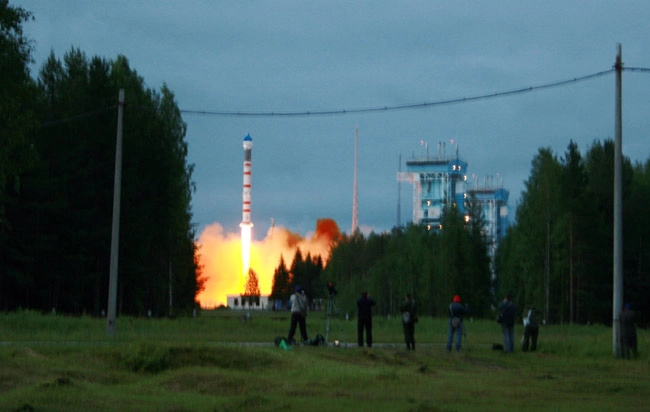
Another German militaryradar reconnaissance satellite launched from Russia last week, joining anorbital constellation of craft designed to peer through the night to spy onlocations around the world.
The craft, called SAR-Lupe4 by the German military, began a half-hour trip to space at 1715 GMT (1:15p.m. EDT) on March 27 from the Plesetsk Cosmodrome in far northern Russia,according to OHB-System, the prime contractor.
The 105-foot-tall Kosmos 3Mrocket lofted the 1,700-pound satellite to an orbital perch about 300 mileshigh.

The launch was postponedtwo days due to unfavorable upper level winds, according to Russian mediareports.
Engineers at a Germancontrol center successfully contacted SAR-Lupe 4 about 90 minutes afterliftoff, confirming the satellite was in good health, OHB-System said in awritten statement.
Officials expect to receivethe first images from the satellite by the end of next month, the company said.
SAR-Lupe 4 joins a fleet ofthreeidentical spacecraft already in orbit to provide detailed imagery for theGerman armed forces. Each satellite is fitted with a radar system to beam radiolight toward Earth and process the reflected pulses to produce high-resolutionimages.
The synthetic apertureradar, or SAR, can spot objects on the ground as small as three feet, accordingto OHB-System.
Radar beams can piercedarkness and clouds, providing an all-weather system able to generate usefulimagery 24 hours a day. Optical systems are obscured during nighttime and badweather conditions.
A final SAR-Lupe satelliteis scheduled to launch later this year to complete the system, which willspread the five spacecraft among three orbital planes to provide regular globalcoverage.
The German military tookcontrol of the early members of the SAR-Lupe fleet in December to beginoperational reconnaissance work, which is expected to last at least ten years.
The SAR-Lupe system is partof an agreement between Germany and France to share imagery between thenations' space-based reconnaissance networks. Germany will receive data fromthe French Helios optical and infrared satellites.
- NEW VIDEO: Europe Launches First ATV Cargo Ship
- NEW GALLERY: Launch Day for Shuttle Endeavour
- IMAGES: 20 Great Rocket Launches
Copyright 2008 SpaceflightNow.com,all rights reserved.
