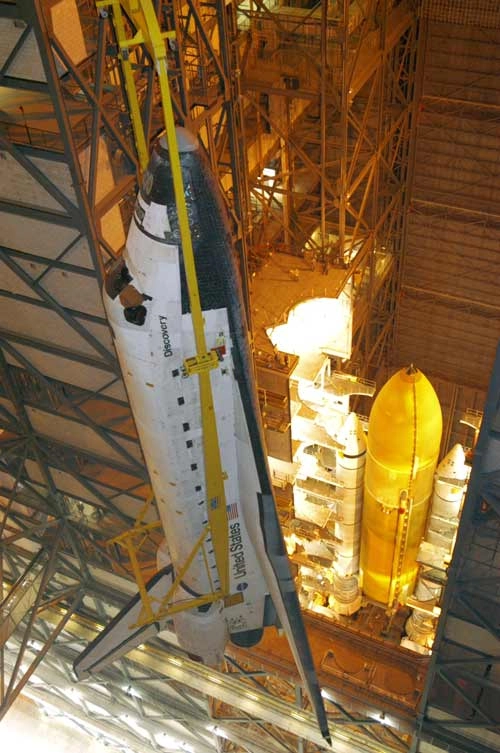
NASHVILLE, Tenn. -- While NASA's space shuttle Discovery prepares to roll out to its launch pad, a team of engineers are working through a mountain of safety waivers to ensure the orbiter is safe for flight.
"We're very close, but I don't know if we're going to have every one examined [by launch day]," NASA's space shuttle deputy manager Wayne Hale told reporters Wednesday. "We will likely have some handful of waivers for the flight."
As part of NASA's return to flight efforts, the space shuttle program has turned waiver approval over to a safety panel dubbed the Independent Technical Authority (ITA), which is separate from the shuttle program and headed by the agency's chief engineer, Rex Geveden.

"In the case of Columbia, [the shuttle] program office really owned all the technical requirements, but also evaluated itself on them, and that's the thing," Geveden told SPACE.com. "You really ought to have an independent panel so that you can look at [waivers] without the pressure of cost and schedules."
NASA's Columbia space shuttle and its crew were lost during reentry on Feb. 1, 2003, when damage incurred during launch caused the orbiter to break up over Texas. Since then, the agency's three remaining orbiters have been grounded.
Discovery, NASA's first shuttle to launch since Columbia's loss, is currently slated to lift off no earlier than May 15 of this year. The orbiter will carry NASA's STS-114 mission, commanded by veteran astronaut Eileen Collins, to test new tools and procedures for shuttle safety, as well deliver much needed supplies to the International Space Station (ISS).
Weeding out waste waivers
Waivers occur when NASA engineers find potential glitches in orbiter systems that could affect the safety or performance of a shuttle during flight. But before the Columbia accident, the waiver system was woefully ineffective, NASA officials said.
"The waiver system at NASA prior to Columbia was inappropriate," said Hale. "We had a huge number of waivers that clogged the system, not allowing us to sift out the safety concerns."
Before Columbia launched in January 2003, about 6,000 waivers sat on the orbiter's books, most without any plans to address or eliminate them from the roster, Hale added.
"There has been a lot of energy spent over what will constitute a waiver," Geveden said, adding that flight rule modifications or other emergencies may spur new waivers. "It's not just designs and drawings."
But since then, shuttle and ITA officials have managed to weed out hundreds that were simply obsolete since they referred to components that were no longer used aboard shuttles. Hundreds more were thrown out because they were impractical, such as one arcane requirement that called for a waiver for each piece of flight hardware that emits electromagnetic interference.
"Even your watch emits some interference," Hale said, adding that the regulation was written in the 1970s, before laptop computers were regular items on flight manifests. "[And] some of these waivers were based on designs of the shuttle before the first orbiter flight.
The waiver necessity
According to NASA's most recent edition of its return to flight implementation plan, a large number of waivers could be unavoidable if the space agency were forced to launch a rescue shuttle to pick up a stranded orbiter crew at the International Space Station.
"If you have to change a flight rule in the middle of a flight, like in a 'safe haven' contingency, then that will be looked at by the Technical Authority," Geveden said.
But some waiver habits, it seems, are hard to shake.
"As we were rolling Discovery over [this week] some engineers came to be with a sheaf of waivers for minor issues," Hale said.
One of the 25 waivers, he added, concerned a blemish on a seal, which an engineer wiped away with a cloth. But since the engineer addressed the smudge on his own before seeking approval-- which was eventually granted - from hardware designers, the procedure technically required a waiver.
"A waiver implies that something has a safety concern," said Hale, adding that he expects at least a few true safety waivers to be addressed for Discovery's flight. "And I also want to make sure that every one of those has a retirement plan."
