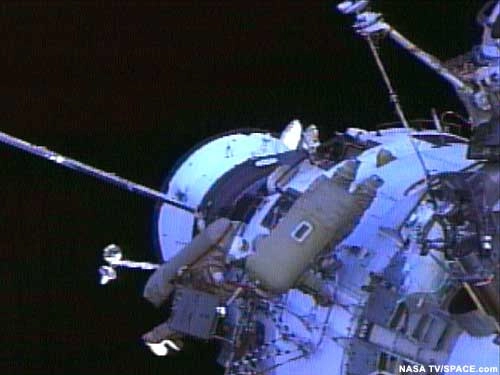
As the tenth crew of the International Space Station (ISS) tends to its orbital home this month, the station itself marks its fourth year with humans continuously living onboard.
For NASA officials, the anniversary marks the end of a year of firsts for the ISS that included unprecedented repairs and spacewalks for two space station crews.
In February, Expedition 8 commander Michael Foale and flight engineer Alexander Kaleri stepped outside the ISS for the first spacewalk without a human crewmember inside.

A few months later a new station crew, Expedition 9'sGennady Padalka and Michael Fincke, flawlessly performed a riskyspacewalk to repair a U.S. ISS component while wearing Russian Orlan space suits and starting from the Russian segment.
"It is a testament that we've learned a lot about adaptingto conditions in space," said Mark Geyer, NASA's ISS managerfor integration and operations, in a telephone interview.
Humans have lived onboard the ISS since Nov. 2, 2000, when the three-man crew of Expedition 1 set foot inside the orbiting station.
"It was a foggy day," Geyer said of Expedition 1's Oct. 31launch from Baikonur Cosmodrome in Kazakhstan. "It was a long trip to see a three-second launch."
Geyer stressed that while humans have lived continuously aboard the ISS since 2000, they have lived in space much longer. The Russians had a near-continuous presence aboard Mir since 1996.
"So humans have been in space now for quite a long time, which forces engineers and operators to continue to be creative," Geyer said. "Especially for the 24/7 operations that will be required for future space exploration missions."
In the last year, two-person crewshave replaced the standard three-person ISS expeditions since the loss of Columbia in February 2003and the grounding of NASA's space shuttle fleet. Without the shuttle's downmass capabilities, cargo has cluttered the station and ISS crews have had to find ways of repairing equipment that would normally be sent back to Earth.
"What you have to trade it against is the crew time required to repair something than to send it back on a shuttle," Geyer said.
The Expedition 8 crew performed a meticulous gyroscoperepair on the station's exercise treadmill during their stay at the ISS.Meanwhile, Expedition 9's Fincke performed a feat some engineers thought impossible, the disassembly and repair of a faulty U.S. space suit and replacement of a small rotor pump deep inside the suit's cooling system.
NASA astronaut Leroy Chiao, the station's current commander for Expedition 10,has continued those space suit repairs on a second U.S. space suit. On the spacestation's fourth Nov. 2 with a crew aboard, Chiao also became the first astronaut to vote in a presidential election from space.
More firsts are planned for the ISS in the year ahead. Among them is the arrival of the European Space Agency's unmanned Automated Transfer Vehicle Jules Verne, a supply ship expected to dock at the station in fall 2005. The Japanese Aerospace Exploration Agency (JAXA) is also developing an unmanned supply ship designed to be captured by the station's robotic arm and connected to Node 2.
"These are different launch vehicles and systems based atdifferent launch sites, which adds a lot of flexibility to servicing thestation," Geyer said. "That international [participation] is key."
