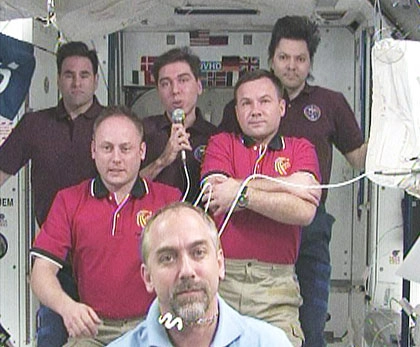
CAPE CANAVERAL, Fla. (AP) -The world's latest space tourist, a computer game wizard and astronaut's sonwho paid $30 million to fly to the space station, said Monday from orbit thathe's gotten his money's worth.
With his 12-day adventurewinding down this week, RichardGarriott said he felt fulfilled even before herocketed away on a Russian Soyuz spacecraft on Oct. 12, thanks to all thetraining he got with astronauts and other space professionals.
"Of course, it's beengreat icing on the cake to actually take the rocket ride, which was veryexciting, and, of course, the view from up here is spectacular," he toldreporters in a news conference.

Garriott said it's beenespecially gratifying speaking from space with his father, retiredastronaut Owen Garriott, 77, who flew on NASA's first space station,Skylab, in 1973. The younger Garriott is the first American to follow a parentinto space.
The two have chattedseveral times each day by radio hookup arranged by Russian Mission Controloutside Moscow. Their next conversation will be face-to-face at the Soyuzlanding site in Kazakhstan on Friday.
"That's been a realjoy, not just talking to him here from space, but this whole year we'veactually spent working together for this flight," said the 47-year-oldGarriott. "It's been a great opportunity for us to bond, so to speak, asadults in ways that we haven't had a chance to do in many years."
Garriott, who lives inAustin, Texas, and goes by the gaming moniker "Lord British," is thecreator of the Ultima computer game series. His most recent business withbrother Robert, Destination Games, merged with a South Korean gaming giant,NCsoft. Garriott is an executive producer of the American branch, NCsoftAustin.
Back at NASA's Floridalaunching site, meanwhile, attention was focused Monday on a mission that hasbeen delayed. Space shuttle Atlantis was hauled off the launch pad and sentback to the hangar to wait until at least February for a trip to the HubbleSpace Telescope.
Atlantis was originallyscheduled to blast off this month on a mission to make various repairs andupgrade the telescope. But the Hubble broke down three weeks ago and stoppedsending pictures, forcing NASA to figure out what went wrong and delay itsmission until next year.
Now astronauts will needtime to train for a new telescope repair they hadn't planned on.
Shuttle Endeavour, now atthe front of the flight lineup, will be moved from its launch pad to Atlantis'spot this weekend. Endeavour had been poised to blast off as a rescue ship forAtlantis' crew if there was an emergency during the Hubble mission. Instead,Endeavour will carry seven astronauts to the space station on an equipmentdelivery mission; launch is targeted for Nov. 14.
That trip will enable NASAto double the number of astronauts living at the orbiting outpost, from threeto six. That transition should occur next spring.
Space station astronautGregory Chamitoff said Monday it feels "very productive" to havedouble the number on board. He'd been living with two Russian cosmonauts sincethe beginning of June and welcomed the arrival of three new faces one week ago.Later this week, those two cosmonauts and Garriott will return to Earth andleave Chamitoff, fellow NASA astronaut Michael Fincke and Russian YuriLonchakov behind in orbit.
"We've gone for 4?months, the three of us, and it's very exciting to have a full complement uphere," said Chamitoff, who will come home aboard Endeavour.
The 18-year-old Hubble,meanwhile, has been unableto send back pictures of the cosmos since Sept. 27. Flight controllerstried unsuccessfully to get a backup system working last week, and may makeanother attempt later this week.
When they do fly, theHubble repair crew members will take up a replacement part for the disabledsystem.
RichardGarriott is chronicling his spaceflight training and mission at his personalWeb site: www.richardinspace.com.
- New Video - The Garriotts: An American Space Legacy Part 1, Part 2
- Video - Space Station Acrobatics
- Future of Flight: Space Tourism, Investment and Technology