Thisstory as updated at 5:47 p.m. EDT.
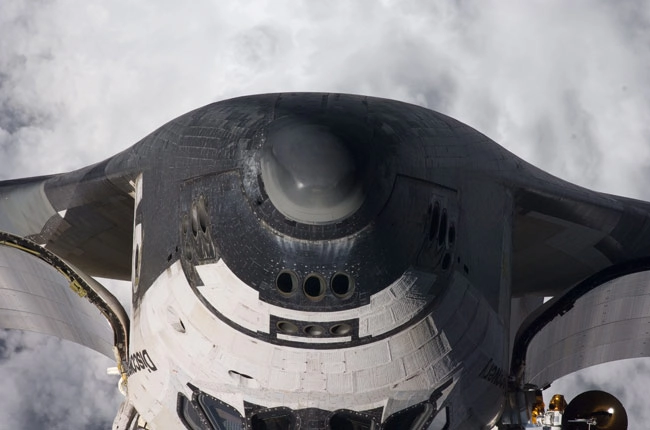
Astronautsaboard the space shuttle Discovery gave their spacecraft?s heat shield a finalhealth check on Thursday to search for any dings from space junk.
Shuttlecommander Lee Archambault and his crew scanned the spacecraft for any newdamage caused by micrometeorites or orbital debris as they prepare for aplanned Saturday landing to enda landmark mission that boosted the International Space Station to fullpower.

?To theuntrained eye, it looked very, very clean,? shuttle flight director Paul Dyesaid as the inspection ended.
Spacedebris has been a growing concern of late, with Archambault using Discovery?sthrusters to help movethe space station clear of a piece of orbital junk earlier this week. Itwas the third debris event in two weeks for the station, one of which sentits three-astronaut crew to take shelter in its docked Soyuz lifeboat whena piece of space trash zoomed close by without enough warning to move theoutpost.
?It?s partof the business,? NASA deputy shuttle program manager LeRoy Cain said of spacedebris last week. ?It comes with the territory and we?ll continue to dowhatever is necessary to avoid debris where and when we know about it.?
Cain saidthe recent spate of spacedebris events, which were brought to the forefront by a Feb. 10 crashbetween two satellites, are random occurrences. Archambault, too, has said therecent events were likely just by chance.
?We havehad a couple of these in the last couple of weeks, but as a far as I know it?scoincidental that we?ve had just a couple in this close timeframe,? Archambaulttold reporters earlier this week.
Discovery undockedfrom the space station Wednesday after eight days of construction workinstall the outpost?s last set of solar wings. The shuttle beamed back thefirst views of the space station with all four of its solar arrays, two perside, as it backed away from the station and began the trip home.
?It reallywas spectacular,? a shuttle astronaut radioed Mission Control last night.
Heatshield check
In theirinspection today, the shuttle?s seven-astronaut crew used cameras and lasersensors at the tip of Discovery?s 50-foot (15-meter) inspection boom to scanthe heat-resistant panels lining its wing edges and nose cap. The survey, anow-standard late heat shield inspection, is identical to one performed by theastronauts just after launch.
Discovery?sheat shield has already received a clean bill of health with respect to launchdebris from its March 15 liftoff. A small ding near the aft on a left wingelevon is the most notable damage, but not a threat to the shuttle or itsastronaut crew, mission managers have said.
Thursday?ssurvey is designed to search for new damage cause by tiny space rocks or otherdebris while Discovery was docked the space station.
NASA haskept a close watch on the integrity of its shuttle heat shields since thetragic 2003 loss of the shuttle Columbia and its astronaut crew duringre-entry. A piece of fuel tank debris damaged that shuttle?s left wing duringlaunch, leading to its destruction during re-entry.
Discovery?sheat shield, by comparison, appears to be in extremely fine shape. Engineerswill study the data and images from today?s survey before clearing the shuttlefor its planned Saturday landing at the Kennedy Space Center in Cape Canaveral,Fla.
Discoveryis completing a 13-day mission to the International Space Station, whereshuttle astronauts performed three spacewalks to install the new solar wings.They also helped repair the station?s urine recycler and replaced one member ofthe outpost?s crew - NASA astronaut Sandra Magnus - with Japanese astronautKoichi Wakata.
Wakata isJapan?s first long-term resident of the space station and due to return toEarth in three months. Magnus will complete a 4 1/2-month mission to stationwhen she returns with Discovery?s crew on Saturday.
Discoveryleft the space station one day before the launch of a Russian Soyuz spacecraftcarrying the outpost?s new crew and the world?s first repeat space tourist -American billionaire Charles Simonyi. Simonyi is paying about $35 million forhis second trip to the station in two years in a deal brokered with Russia?sFederal Space Agency by the Virginia-based firm Space Adventures.
TheSoyuz lifted off on time at 7:49 a.m. EDT (1149 GMT) from the Central Asianspaceport of Baikonur Cosmodrome in Kazakhstan. It is due to arrive at thestation on Saturday at 9:14 a.m. EDT (1314 GMT), a few hours before Discoveryis slated to land in Florida.
SPACE.comis providing continuous coverage of STS-119 and Charles Simonyi?s with reporterClara Moskowitz and senior editor Tariq Malik in New York. Click here for shuttlemission updates and SPACE.com's live NASA TV video feed.
- New Video - See the Space Station From Earth
- Video - Meet the Expedition 19 ISS Crew
- Video - Fragmentation: The Expanding Danger of Space Debris
