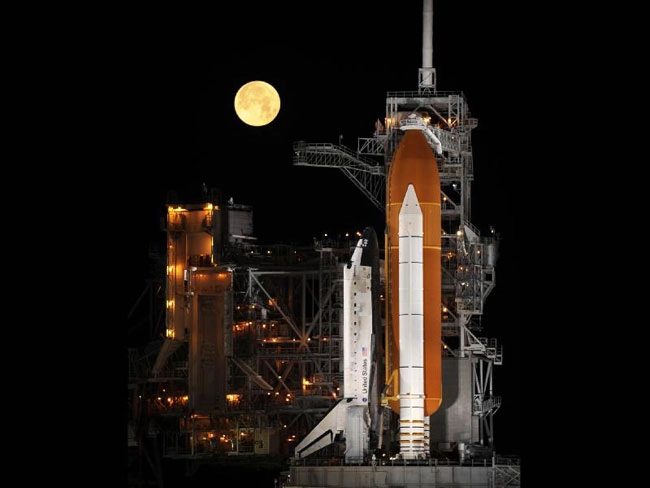
The space shuttle Discovery is on track for a plannedSunday evening launch, pending the successful repair of a hydrogen gas leakthat prevented an attempted liftoff earlier this week, NASA officials saidtoday.
Engineers have been studying the problem, a hydrogen gasleak from a vent line connected to the vehicle's external fuel tank, that thwarteda launch attempt on Wednesday. Ground crews are in the process of replacing theconnector segments between the vent line and the tank in hopes that this willenable Discovery to liftoffon Sunday at 7:43 p.m. EDT (2343 GMT).
"We're going to replace these components and getinto a launch attempt Sunday," said shuttle launch director Mike Leinbachduring a morning briefing at NASA?s Kennedy Space Center in Cape Canaveral,Fla. "If it doesn?t leak, we're going to fly. If it does leak again we're goingto stand down."

Discovery had already begun its launch countdown lastWednesday when ground crews at NASA's Kennedy Space Center in Cape Canaveral,Fla. noticedthe gas leak coming off a cable that allows excess pressure to vent fromthe fuel tank. The leak forced NASA to immediately begin unloading fuel fromthe tank and cancel the launch that day.
Finding the problem
Shuttle engineers have been examining the connectionbetween the shuttle's tank and the faulty vent line since Wednesday and believethe issue to be with a seal there.
"We're into the detailed inspection of thecomponents right now," Leinbach said. "We don?t have any smoking gunsyet."
NASA hopes to fix the leak by replacing a connectorsegment of the 7-inch (18-cm) hydrogen vent line, which siphons flammablegaseous hydrogen away from safely the launch pad, so it does not pose an explosionrisk to the shuttle or crew. The hydrogen gas builds up in the fuel tank as shuttle'ssuper-chilled liquid hydrogen propellant is loaded in and then boils off overtime.
Shuttle technicians will do a series of leak checks onthe newly-configured system before launch, but they won't really know if the repairedvent line is leak free until it is tested under the super-cooled temperaturesit will experience Sunday night when the tank is fueled for launch.
Shortened mission
NASA has until Tuesday to try and launch Discovery?sspace station construction flight before the liftoff of a previously scheduledcrew change mission aboard a Russian-built Soyuz spacecraft on March 26.
If Discovery successfully launches on Sunday, there willstill be enough time for its seven-astronaut crew to complete most of its missionplan, shuttle managers said. The mission, originally slated to last 14 days,with four spacewalks, will be shortened by one day with one spacewalkeliminated, to make room for an incoming Russian Soyuz spacecraft set to launchMarch 26.
"Effectively, we'd accomplish most of themajor objectives," said mission management chair Mike Moses.
If Discovery cannot launch until Monday, then two daysand two spacewalks would likely be cut. A Tuesday liftoff would most likelymean an 11-day mission with only one spacewalk. If the shuttle cannot launch byTuesday, it will stand down until April 7 to let the Soyuz mission fly. NASAwants to avoid docking the shuttle and Soyuz simultaneously at the station toavoid crew workload and spacecraft concerns.
Discovery's delay has also hindered plans to launch a newU.S. military communications satellite from the Cape Canaveral Air ForceStation near Discovery?s seaside pad at the Kennedy Space Center. The WidebandGlobal SATCOM-2 satellite was due to launch Saturday atop an Atlas 5 rocket, butwill stand down until next week after Discovery?s planned liftoff.
Discovery's trip
Discovery's STS-119crew, commanded by Lee Archambault, is set to launch toward theInternational Space Station to drop off the station's remaining backbone-likegirder segment and final set of solar array panels. The shuttle?s STS-119mission will also deliver Japanese astronaut Koichi Wakata, who is due to serveas Japan's first long-duration astronaut when he replaces NASA astronaut SandraMagnus as part of the space station's Expedition 18 crew.
The gas leak delay is only the most recent setback forDiscovery's mission, which had previously been pushed back about a month due toconcerns with suspect fuel valves on the orbiter.
SPACE.com is providing continuous coverage of STS-119with reporter Clara Moskowitz and senior editor Tariq Malik in New York. Click here for missionupdates and SPACE.com's live NASA TV video feed.
- New Video - Meet Discovery's STS-119 Shuttle Astronauts
- New Video - Discovery's Mission: Space Station Power Up!
- New Show - NewSpace: The Orbital Industrial Revolution
