This story was updated at 2:15 p.m. EDT.
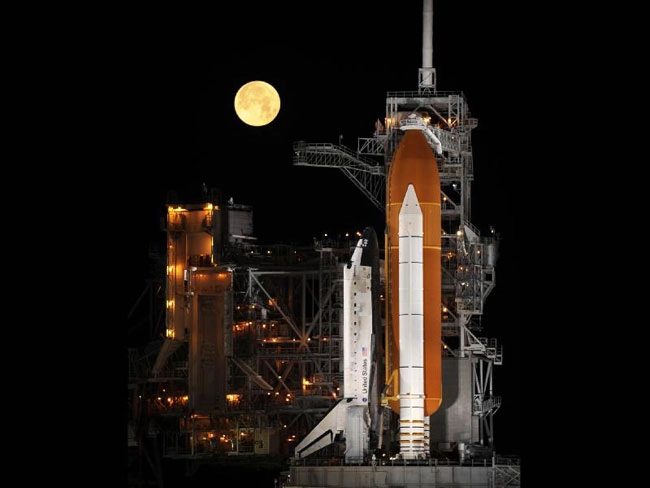
When NASA?sspace shuttle rockets into orbit tonight, it will do so under the placid glowof a nearly full moon.
The moonwill rise over Discovery?s seaside launch site at NASA?s Kennedy Space Centerin Florida at about 7:20 p.m. EDT tonight (2320 GMT), two hours before the shuttle?splanned liftoff at 9:20 p.m. EDT (0120 March 12 GMT).

A NASAphotographer caught a preview late Tuesday of the lunar event, showing a brightround moon shining down over the launch-ready Discovery. While the moon was officiallyfull yesterday, it will look almost identical tonight.
"Itshould be a beautiful launch," NASA weather officer Kathy Winters saidTuesday. "We're going to have that full moon out, so that's going to bereally nice too."
Discovery?snight launch will mark NASA?s second nocturnal shuttle space shot in a row. Thelast mission, by shuttle Endeavour, launched into space on Nov. 14, 2008 in aliftoff also accompanied by a nearly full moon. Tonight, skywatchers along muchof the Eastern Seaboard should be able to spotthe shuttle as it rockets into the sky.
But Discovery?sfull moon setup is mere coincidence. The shuttle was initially slated to launchon Feb. 12, nearly a month ago, just after sunrise. But the mission was delayedseveral times due to fuel valve concerns that have since been resolved.
Discovery?splanned Wednesday night liftoff will be NASA?s 125th shuttle launch, but onlythe 32nd to blast off at night. It is Discovery?s 27th shuttle mission.
Commandedby veteran shuttle flyer Lee Archambault, Discovery?sseven-astronaut crew will launch toward the International Space Stationcarrying the outpost?s final pair of U.S.-built solar wings and the lastsegment of its backbone-like main truss. The14-day mission will also ferry Japanese astronaut Koichi Wakata to thestation, where he will replace NASA astronaut Sandra Magnus as a member of theorbiting lab?s three-person crew. Wakata is Japan?s first long-durationastronaut and will return to Earth later this summer.
BecauseDiscovery is launching at night, it is carrying a camera with a special flashto snap pictures of its attached external tank after jettisoning the 15-storyfuel tank once the shuttle is in orbit. The flash photos allow engineers toinspect the tank?s foam-covered insulation as a safety measure.
SPACE.comis providing continuous coverage of STS-119 with reporter Clara Moskowitz atCape Canaveral and senior editor Tariq Malik in New York. Click here for missionupdates and SPACE.com's live NASA TV video feed.
- Night Shuttle Launch Visible from Most of East Coast
- New Video - Meet Discovery's STS-119 Shuttle Astronauts
- New Video - Discovery's Mission: Space Station Power Up!
- Gallery: Night Launch of STS-126
- Full Moon Names for 2009
- The Disappearing Moon: Why and Where it Hides
