This story was updated at 6:34 a.m. EDT.
HOUSTON — A new Japanese robotic arm outside the International Space Station (ISS) is set to make a brief orbital debut Saturday to set the stage for a spacewalk tomorrow.
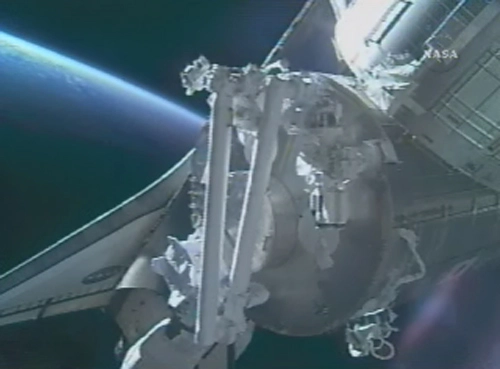
The arm, a six-jointed limb folded up over itself, is the external reach of Japan's $1 billion Kibo laboratory and arrived with the tour bus-sized module earlier this week aboard NASA's space shuttle Discovery.

Astronauts are expected to move the 33-foot (10-meter) robotic arm just a bit this afternoon so spacewalkers will be able to remove insulation covers and free restraints on Saturday that will allow the arm to flex its full length during shakedown tests set for Monday.
"It will be pretty slight, you will be able to see it," space station flight director Annette Hasbrook told reporters late Friday here at NASA's Johnson Space Center.
But however small, today's planned robotic arm twitch will make a bit of space history as the first time an astronaut has wielded three separate robot arms in orbit.
NASA astronaut Karen Nyberg, the chief robotic arm operator for Discovery's STS-124 mission, has already commanded the shuttle's 50-foot (15-meter) robotic arm and the space station's 57-foot (17-meter) powerhouse grapple that has proven so handy for the outpost's orbital construction.
She will also wield Japan's new robotic arm with Japanese astronaut Akihiko Hoshide, who Mission Control roused this morning with the song "Taking Off" by the Japanese band Godaigo.
"Thanks for the song and thanks for everyone who's supporting this mission," Hoshide said. "With your help, we're taking off to the future with your hopes and dreams. Thanks a lot."
Science arm's small move
Kibo's robotic arm has a different mission than its shuttle and station brethren, but the basics of its flight resemble those of the shuttle and station limbs, Nyberg said.
"The three arms are similar in theory and actually are basically the same mechanically," Nyberg said before flight. "What I think is really neat is how they're used differently."
The shuttle's arm has been used to handle cargo and — more recently-guide a 50-foot (15-meter) inspection pole on detailed heat shield inspections, while the station's arm was specifically designed to serve as a construction crane in space.
But Kibo's main Japanese arm is designed primarily to manipulate small experiments. It weighs about 1,719 pounds (780 kg) and can haul objects as massive as 15,432 pounds (7,000 kg).
Future astronauts are expected to use the Japanese arm to grapple experiments from a small airlock on Kibo and move them about a porch-like external platform that is slated to launch toward the space station on a NASA shuttle next year. A second, smaller arm will also be added later to aid the larger Kibo limb's dexterity.
"The Japanese arm is going to be used primarily for scientific research," said Nyberg, who became the 50th woman ever to fly in space when Discovery launched on May 31. "They're pretty similar, operated differently, but I think it's pretty neat what they're doing."
While Nyberg and Hoshide move the arm, their crewmates will be busy outfitting a vestibule that connects the 37-foot (11-meter) Kibo lab to its attic-like storage module. Astronauts attached the module to the roof of Kibo on Friday.
The spaceflyers are also scheduled to discuss their orbital work with reporters and dignitaries in Japan among their other tasks.
Engineers on Earth, meanwhile, are expected to study images today of two heat shield panels along Discovery's wings, where sensors designed to record debris strikes returned odd signals earlier in the shuttle's flight. The signals aren't expected to pose a concern, but engineers want to make sure.
Shuttle astronauts snapped about 50 high-resolution photographs of the panels and sent them back to Earth for analysis.
Commanded by veteran shuttle flyer Mark Kelly, Discovery's seven astronauts are in the middle of a planned 14-day mission to install Japan's Kibo lab at the station and swap out a member of the outpost's three-man crew. The shuttle is slated to cast off on Wednesday for a planned June 14 landing in Florida.
NASA is broadcasting Discovery's STS-124 mission live on NASA TV on Saturday. Click here for SPACE.com's shuttle mission updates and NASA TV feed.
