HOUSTON - NASA shuttle officials are withholdinga final judgment on whether the Discovery orbiter's heat shield is safe for thereturn trip until after a team of analysts completes a meticulous survey of theup-close images taken during a Friday inspection.
"They maytell me tomorrow, they may tell me Sunday," said John Shannon, NASA's deputyshuttle program manager, of when analysts expect to complete their work. "I'llget it when I get it."
OnThursday, Shannon expressed hope Discovery's heat shield would be cleared forreentry by the end of this weekend.

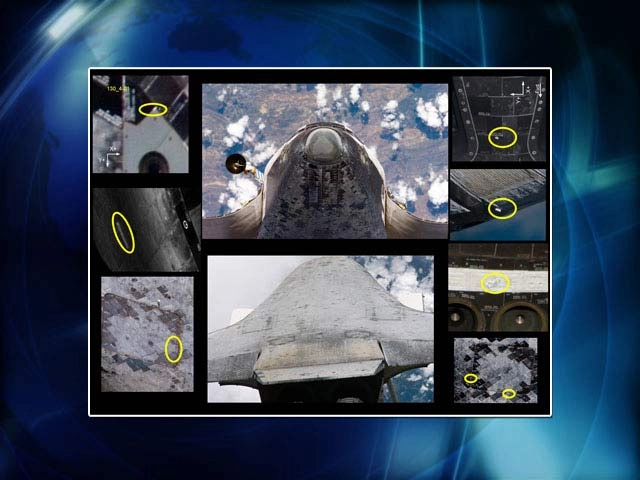
Earliertoday, STS-121 mission specialists StephanieWilson, LisaNowak and shuttle pilot MarkKelly relayed home a batch of high-resolution images aimed at cementing thecase. The imagery featured six key areas that engineers requested after goingthrough photographs of Discovery's heat shield snapped from the InternationalSpace Station (ISS) during Thursday'sdocking.
Of thosesix areas, several appear to have been settled - among them a frayed bit offabric from a so-called "tadpole" gap filler just aft of Discovery's noselanding gear and a small white blotch on the orbiter's nose - though NASAorbiter project manager Steve Poulos said final imagery analysis is stillpending on both items.
Poulos saida bit more scrutiny is required over a protruding gap filler peeking up perhapsan inch above the surrounding heat-resistant belly tiles near the orbiter'swing flap. The protrusion is near door that covers an external tank connectionand could lead to higher than expected heating aft of the gap filler thanreentry. Analysis of both the thermal and structural effects of such heating isanticipated to be complete by Sunday, he added.
Several imagesof sites along the middle of Discovery's starboard - or right - wing leadingedge have caught the eye of analysts as well, since they show dark marks on theheat-resistant reinforced carbon carbon panels that experience some of thehighest temperatures - up to 2,960 degrees Fahrenheit - seen during reentry.
"Once we getthe high fidelity imagery, it's either not an issue or something we'll need tobe worried about," Poulos said if the RCC panel areas. "I think we'll have thatinformation here this evening."
Aside fromthe six suspect areas, Poulos said Discovery is in ship shape.
"Orbitersystems couldn't be functioning better," Poulos said. "We are really nottracking anything significant, hardly anything at all to be honest."
Discoveryis flying NASA's second shuttle flight since the 2003 Columbia accident.Recently extended one day to a 13-day mission, the STS-121 spaceflight willresupply the ISS, leave a third crewmember aboard, make repairs to the outpostand test shuttle inspection and repair methods.
- Gallery: Shuttle's First Flight
- Gallery: Rare Space Shuttle Images
- Shuttle Discovery: Complete Mission Coverage
- Great Space Quizzes: Space Shuttle Countdown
- Great Space Quizzes: The Space Shuttle
- Great Space Quizzes: Life in Orbit
