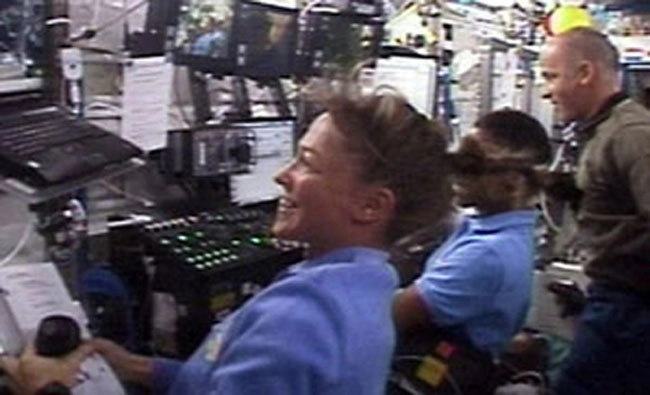
HOUSTON - With nine astronauts aboard theInternational Space Station (ISS), NASA's space shuttle Discovery has alreadymet one of the major goals of its STS-121 spaceflight, a mission flightdirector said Thursday.
Tony Ceccacci, lead shuttle flight director for Discovery's STS-121 mission, saidthe orbiter's docking at the ISS today marks the start of a spaceflightmarathon for the shuttle's seven-astronaut crew.
"They'reall pumped up and ready to go," Ceccacci said ofDiscovery's crew during a mission update here at Johnson Space Center (JSC). "Ithink they're probably going to be on an adrenaline rush until we get the mainshuttle nose gear touchdown on entry day."

Veteran spaceflyer StevenLindsey, commander of Discovery's STS-121 mission, eased the 100-ton spaceplane into a berth at the end of the space station's U.S.-built Destiny lab at 10:52 a.m. EDT(1452 GMT) today. Less than two hours later, Lindsey and his six STS-121crewmates were exchanging handshakes and hugs with ISSExpedition 13 commander Pavel Vinogradov and flightengineer JeffreyWilliams.
"I'm veryhappy how things are going," Ceccacci said.
Among thehighlights of today's orbital rendezvous was Discovery's orbitalback flip, which Lindsey conducted while flying just 600 feet (182 meters)below the ISS. During that time, Vinogradov andWilliams snapped hundreds of still images that were later relayed down toEarth. But the event was also broadcast live via cameras attached to the spacestation's exterior.
"A pictureis worth 1,000 words, how beautiful that looked," Ceccaccisaid of the shuttle back flip, known as a rendezvous pitch maneuver. "We're allinterested in the digital photography that the station crew took."
Going bythe numbers, Vinogradov and Williams took 350pictures of Discovery between them while Lindsey put the orbiter through itsorbital back flip. About 125 of those images have been downloaded by missioncontrollers on Earth for waiting analysts. The rest are expected to be receivedby late this afternoon for study to determine the health of Discovery's heatshield, Ceccacci said.
Meanwhile,the space station hit a major milestone this afternoon, when STS-121 missionspecialist ThomasReiter moved his Soyuz seat liner into a Russian-built spacecraft alreadydocked at the station. Coupled with a safety check of Reiter's Russian-built Sokol flight suit, the seat liner installation almostassures Reiter's position as the third ISS crewmember.
Spacestation crews have been limited to two astronauts since the 2003 Columbia accident, duethe drop in supplies that followed the grounding of NASA's shuttle fleet.
Reiter isthe first German citizen to visit the ISS and the first European Space Agency(ESA) astronaut marked for an extended tour aboard the orbital outpost.
Ceccaccisaid that while Reiter has returned the ISS to its three-person capacity onpaper, space station flight controllers are holding their judgment until all ofhis supplies, personal items and other equipment are stowed aboard the orbitallaboratory.
"Of course,the majority of those are on the MPLM side," Ceccaccisaid, adding that the supplies are still packed inside the Italian-builtLeonardo cargo container - known as a Multi-Purpose Logistics Module (MPLM).
In amission summary uplinked to the STS-121 crew thismorning, flight controllers reported that the sensors behind each ofDiscovery's wings recorded three impacts each, which appear similar to thoseseen during Discovery's STS-114 flight.
"There maybe some correlation between the two missions," the crew summary reported.
Ceccaccisaid mission managers will likely discuss those issues during an STS-121Mission Management Team meeting later today.
Anin-flight fix to a finicky thruster heater - in which Discovery's crew simplyoriented the small left aft thruster towards the Sun to keep it warm - alsoworked as expected during today's ISS docking, and allowed Lindsey to make fineadjustments with the engine, rather than rely on the shuttle's larger reactioncontrol jets, Ceccacci added.
Aside fromthose issues, Discovery's STS-121 mission - and its crew -are sailing quietly along.
"You know,it's boring to us that it's quiet, but that's a good thing," Ceccacci said. "That means everything is going well."
- Gallery: Shuttle's First Flight
- Gallery: Rare Space Shuttle Images
- Shuttle Discovery: Complete Mission Coverage
- Great Space Quizzes: Space Shuttle Countdown
- Great Space Quizzes: The Space Shuttle
- Great Space Quizzes: Life in Orbit
