This story was updated at 2:50 p.m. EDT.
CAPE CANAVERAL,Fla. - Poorweather again thwarted the launch of NASA's space shuttle Discovery Sundayfollowing a day of delays due to thunderstorms and thick clouds.
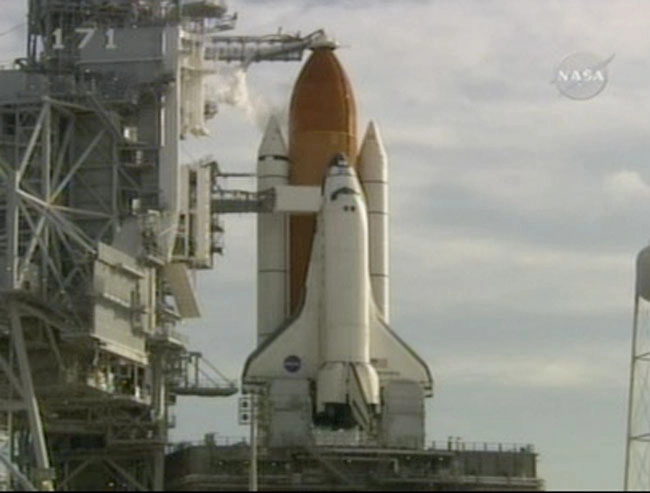
NASA launchofficials scrubbed their second launch attempt in two days for Discovery'sSTS-121mission at 1:15 p.m. EDT (1715 GMT) after a seesaw of sunshine, rain andthunder here at Kennedy Space Center (KSC).

"We've concludedthat we're not going to have a chance to launch today," NASA launch directorMichael Leinbach told the STS-121 astronauts aboardDiscovery. "We've decided to terminate the count for today and stand down for48 hours."
The decision,which came after it became clear there would be no chance to loft Discoverytoday, now pushes the STS-121 launch target to Tuesday, July 4 at2:37:51 p.m.EDT (1837:51 GMT).
"We copy, andlooking out the window it doesn't look good today and we think that's a greatplan, " STS-121 shuttle commander Steven Lindsey toldlaunch controllers.
A press conferenceon today's launch scrub is scheduled for 3:00 p.m. EDT (1900 GMT).
Discovery'sSTS-121 mission is NASA's second shuttle flight since the 2003 Columbia accident. The 12-day spaceflight isexpected to deliver vital supplies to the International Space Station (ISS) anda new crewmember - Thomas Reiter of the European Space Agency (ESA) - for theorbital lab. Shuttle astronauts are also expected to test shuttle inspectionand repair techniques during the spaceflight.
Stormy countdown
At thestart of today's launch attempt, weather forecasters gave the space shot justa30 percent chance of leaving Earth today at 3:26 p.m. EDT (1926 GMT). Clouds, rain or nearby storms violated at least one flightrule - if not more- at one time or another.
"It'salmost easier to talk about what's not violating flight rules than what is," NASAlaunch commentator Bruce Buckingham said early in the day.
A July 4thliftoffat 2:37:51 p.m. EDT (1837:51 GMT) on Tuesday carries the best chance oflaunching Discovery this week, said U.S. Air Force Lt. KalebNordgren, of the45th Weather Squadron atCape Canaveral Air Force Base.
After theupcoming U.S.holiday, weather forecasts predict worsening conditions during launch time atKSC, Nordgren added.
Over thenext two days, pad workers will top off the super-cold liquid hydrogen andliquid oxygen propellants that will power Discovery'sfuel cells during its planned 12-day mission. That activity will allow theshuttle's power system some extra margin for a possible mission extension dayduring the STS-121spaceflight.
NASA officialsand the STS-121 crew are hoping for that 13th mission day.
The extratime could lead to a third spacewalk, which mission managers pulled offtheSTS-121 flight timeline earlier this year, thatwill test shuttle heat shield repair methods.
Woefulweather
Weatherconditions are always a concern during shuttle launches, especially given NASA'sslim, 10-minute window to loft orbiters toward the International Space Station(ISS).
NASA missioncontrollers typically target the middle of Discovery's launch window in orderto secure the best optimum flight profile for the two-day ISS trip.
But inaway, worrying only about weather is a relief, NASA chief Michael Griffin told SPACE.com.
"It'scomforting because we always have the weather, and most of the time we alwayshave something else," Griffinsaid earlier today. "And as best as we can tell right now we don't haveanything else."
NASA astronautScott Kelly, a shuttle commander and the identical twin brother ofSTS-121 pilotMark Kelly, said his brother's enthusiasm remained high despite facing theweather scrubs.
"He'sgetting ready to go into space, of course he's gung ho," Scott Kelly said ofhis twin during today's launch countdown.
Scott Kelly,himself, is no stranger to launch scrubs. He served as shuttle pilot duringNASA's STS-103 mission to the Hubble Space Telescope in 1999. That mission,also aboard Discovery, suffered several days of delays, including one weatherscrub with the crew aboard, before finally reaching orbit.
"We'velaunched when we've had a 90 percent of no go and we haven't launched whenwe've had 10 percent of no go," Kelly said. "You have to be prepared."
- Gallery: Shuttle's First Flight
- Gallery: Rare Space Shuttle Images
- Shuttle Discovery: Complete Mission Coverage
- Great Space Quizzes: Space Shuttle Countdown
- Great Space Quizzes: The Space Shuttle
- Great Space Quizzes: Life in Orbit
