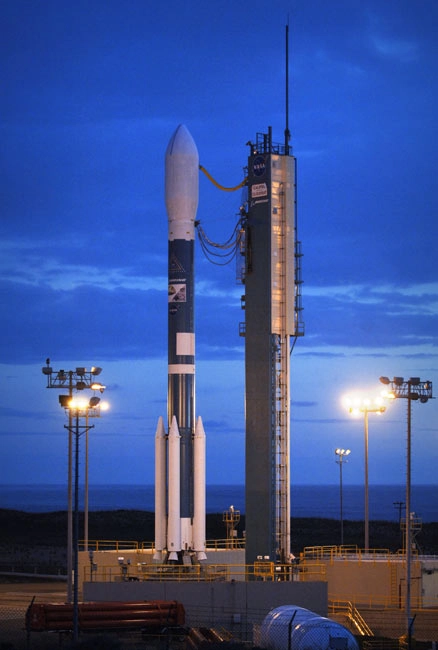
Two NASAsatellites designed to make unprecedented measurements of Earth's clouds andatmosphere must wait yet another day to begin their mission after a high winds preventedtheir launch early Tuesday.
The high upper levelwinds were detected just four minutes before liftoff, forcing flight controllers to scrub the latest launch attempt for NASA'sCloudSatand CALIPSO satellites and their Delta 2 booster. The two satellites were scheduledto rocket spaceward from California's Vandenberg Air Force Base precisely at6:02 a.m. EDT (1002 GMT).
"We are inthe process of preparing for a 24-hour recycle," NASA launch commentator BruceBuckingham said after the scrub, which occurred after what had been a nearlyflawless countdown before the high winds were detected.

Launchcontrollers are now preparing to launch NASA's CloudSat and CALIPSO satelliteson April 26 at 6:02 a.m. EDT, Buckingham said. Because the space shot mustlaunch exactly on time, there is little room to accommodate last minute issuessuch as high upper level winds, he added.
A similarlast-minute glitch - a communications problem with the CALIPSO spacecraft - scrubbedan initial April 21 launch attempt just 48 seconds before liftoff. The unavailabilityof a refueling plane for a radar tracking aircraft required to monitor thelaunch also prevented Saturday and Sunday launch plans, NASA said.
CloudSatand CALIPSO are designed to study clouds and aerosols - fine particlessuspended in Earth's atmosphere - in three dimensions.
The $185million CloudSat mission will use a powerful, 90 gigahertz radar to penetrateclouds and identify individual cloud particles, water and snow. The $223million CALIPSO - or Cloud-Aerosol Lidar and Infrared Pathfinder SatelliteObservations - mission a cooperative effort between NASA and the French SpaceAgency (CNES), and features a laser-ranging lidar instrument and two othertools to study aerosol distribution in the Earth's atmosphere.
Oncelaunched, CloudSat and CALIPSO are expected to reach an orbit of 438 miles (705kilometers) and join France's PARASOLsatellite and NASA's Aquaand Auraspacecraft to make up the "Afternoon Train" Earth-watching system, NASA said.
- Countdown Coverage for NASA's CloudSat/CALIPSO Launch
- NASA Scrubs Launch of CloudSat, CALIPSO Satellites
- NASA Satellite Duo Set for Cloud-Watching Mission
