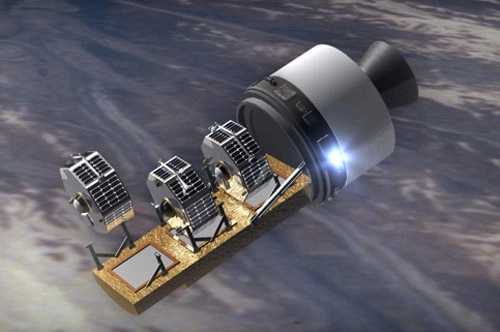
A lastminute glitch forced flight controllers to scrub the Wednesday launch of three NASAmicrosatellites and their Pegasus rocket Wednesday.
The launchabort occurred less than two minutes before NASA's SpaceTechnology 5 mission was set to rocket spaceward from its mothership, an L-1011 jet aircraft, 39,000 feet (11,887 meters) in sky. A locking pindesigned to hold the mission's Pegasus booster to the parent jet'sundercarriage failed to release before the rocket's fin batteries ran out, preventingits planned 9:25 a.m. EST (1425 GMT) launch, NASA officials said.
"That'sgoing to be a 48-hour delay for us at least to change out the fin batteries,"said Omar Baez, NASA's assistant launch director at the mission's VandenbergAir Force Base takeoff point in California.

However, anofficial flight date remains to be determined while engineers determine why thelocking pin stuck and an available launch date is selected, mission managerssaid.
"We don'tknow how long the postponement will be at this point," said NASA launchcommentator George Diller after the scrubbed space shot.
NASA'sSpace Technology 5 mission is part of the agency's NewMillenium program to develop and test new technologies for futurespacecraft.
Each of themission's three, cake-sized probes weighs 55 pounds (25 kilograms) and carrysix technologies to be tested, ranging from a new microthruster for orientationto a skin-like radiator and software for autonomous ground operations.
The probesalso each carry a boom-mounted instrument that will be deployed after launch tostudy the effect of space weather on the Earth's magnetosphere, missionscientists said. The $130 million mission is slated to last about 90 days, NASA said.
- Launch Countdown Coverage of NASA's Space Technology 5 Mission
- Poor Weather Threatens NASA Space Technology Launch
- Technology Test: NASA Microsats Set for Launch
