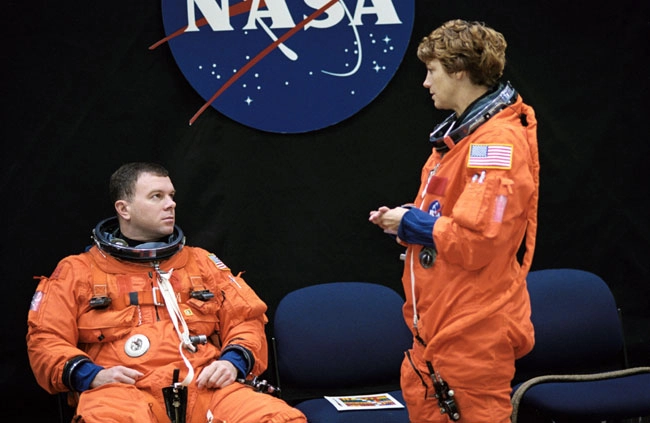
There is noshortage of experience at the helm of NASA's next space shuttle mission.
With atotal of four shuttle flights and 844 hours of space time between them, STS-114commander Eileen Collins and mission pilot James Kelly are well prepared.
The two veteranastronauts are heading up the seven-member crew of NASA's first space shuttleflight since the Columbiadisaster. Discovery, their spacecraft, is now set to launch no earlier than May22 after being delayed Wednesday.

"The launchdate is not important," Collins said during an interview earlier this month."We need to wait and do this right."
The commander
A retiredU.S. Air Force colonel, Collins, 48, joined NASA's astronaut ranks in 1991. TheElmira, New York native has flown on three previous shuttleflights, serving as NASA's first female shuttle pilot during STS-63 in 1995 andthen as the first female shuttle commander aboard the STS-93 mission in 1999.
"I'm not really aware that there's any difference betweenmale and female crewmembers," Collins told reporters. "It may mean something tothe rest of the world that there's a woman commanding this flight, if so that'sgreat. I hope to be a role model for young women to come into this field."
Collinssaid she's focused her primary attention on preparing herself and her crew forthe STS-114 mission, which will test new tools and procedures to enhanceshuttle safety.
"This crew has been so brilliant and motivated, they make myjob easy," she said. "We are aware that that the whole world is watching, butwe're focused on the mission."
Discovery's STS-114 flight will mark a new start for NASA'sshuttle program, which was stalled after the Columbia orbiter broke apart during reentryon Feb. 1, 2003, killing its crew. More than two years later, NASA shuttleofficials say they have a better understanding of the risks involved with humanspaceflight and are confident Discovery's flight will be the safest the agencyhas ever launched.
"I believethat we have studied the risks... and that at this point we are ready to say it'stime to go back and fly," Collins said.
With anairline pilot husband, Collins has told SPACE.com that the risks of flight andspaceflight are well known in her home. She has also taken care to explain herupcoming mission with her two children, showing them video tapes of pastmissions to communicate the importance of NASA's flight program.
"The spaceshuttle is critical to completing the International Space Station," Collinssaid, adding that the station is a springboard to reach out to Mars. "And tome, that is the most exciting dream I have...to see, one day, people walking onthe surface of Mars."
The pilot
Takingstock of NASA's space program and discussing it at home became a focus for STS-114pilot James Kelly, 40, following the loss of Columbia's STS-107 crew.
"You haveto revisit every decision you've ever made to be in the program and fly inspace," Kelly said, adding that he had many discussions with his wife followingthe Columbiaaccident. "We had talked about all of that before, but this time I spent a lotmore time with the kids."
A father offour, Kelly said that while he believes the STS-114 mission carries less riskthan his previous spaceflight - 2001's STS-102 flight aboard Discovery - he tookcare to go over the technical details of his next launch with his two olderboys, ages 15 and 14.
"It makesthem more comfortable, and I talk a lot more about why I do this," Kelly said.
A U.S. AirForce lieutenant colonel, Kelly is both shuttle pilot and an operator for boththe shuttle and space station robot arms during Discovery's flight. The missionis his second trip to the ISS since his 1996 acceptance into the astronaut corps,though he admits the station will likely look much different that the picturein his memory.
"I think the biggest difference I'm going to see is theclutter," Kelly said. "When I got there on my last mission the U.S.lab [Destiny] had just arrived and there was nothing in it."
The lack ofspace shuttle flights to the ISS since the Columbia accident has led to an accumulationof spare parts and other items that cannot be readily returned to Earth aboardthe Russian Soyuz spacecraft currently used to ferry new crews to the station.
Kelly saidhe expects the STS-114 flight to be as busy as STS-102, which was NASA's first 4-personshuttle crew to deliver a fresh astronaut rotation to the ISS, but will stillconsider it a test flight despite his previous experience with the Discoveryorbiter.
"I considerevery flight to be a test flight and I agree when [Columbia investigators] said we have alwaysbeen a test vehicle," Kelly said. "Every shuttle flight has things on it thathave never been done before, this one just has more."
- Fixing NASA: Complete Coverage of Space Shuttle Return to Flight
